
Astrology
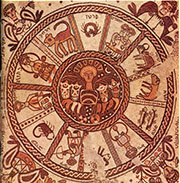
"By Looking Up, I See Downward"
Tycho Brahe (astronomer/astrologer 1546-1601)
Many of the disciplines of modern science grew from or because of the practice of astrology. Astrological ideas spread westward from their origins in Mesopotamia, Egypt, and ancient Greece. As symphony is to musical instrument, astrology was an entire system that put man, nature, and the cosmos into one harmonious accord.
At the beginning of scientific exploration, astronomy and astrology were nearly synonymous. Pythagoras, Plato, Aristotle, Ptolemy, Brahe, Galileo, Kepler, and Newton—many of the great minds of their times formulated their theories based on the Earth's relationships with the stars, the sun, the moon, and the planets in our Universe.3 It wasn't until the 18th Century that astronomy and astrology split and astronomy became a scientific study of the cosmos with no regard to the principles of astrology.4
"Shakespeare constantly makes use of his astrological allusions..."
John Addey5
William Shakespeare was prolific in his use of astrological imagery to move his plots forward and define his characters.5, 6 Among the many plays of Shakespeare, Romeo and Juliet, Alls Well That Ends Well, and King Lear each hold pointed examples of the part astrology played in Shakespeare's world.
Despite the fact that modern science relegates it to a pseudo-science classification, astrology is today perhaps the most popular of all paranormal interests. However, as well as science, astrology has deep ties to ancient religions in the belief that the gods watch over us from the heavens.
Whatever the case, religion or science, the simplicity of using the positions of the sun, moon, and planets to understand our characters and chart our destinies is a magnet for people worldwide. Nearly one-third of Americans believe in the validity of astrology and nearly half of all Americans read their daily Horoscope at least “occasionally”.7 Of course, the extent of this belief varies—some people treat it as light entertainment while others base medical, professional, financial, and personal decisions upon astrological precepts.
"Even if it isn't really 'true', astrology is still a wonderful thing, a fantastically complex and beautiful construct, which draws your eyes up to the heavens and makes you aware that you are a tiny and yet still significant part of the workings of the universe."
David Hamblin (former Chairman of the UK Astrological Association) 9
Astrology Traditions
In Western cultures, the main astrology traditions used by modern astrologers are Vedic Astrology and Western Astrology. Both traditions use a horoscopic system to cast an astrological chart based on the position of the sun, moon, and planets. The difference between the two traditions is that the Western tradition breaks the link between the sign and the constellation, while in Vedic astrology the link remains essential.4
Branches of Horoscopic Astrology
- Natal Astrology (aka Genethliacal Astrology) is the system of astrology used to chart an individual's path through life based on the exact date, time, and location of a person's birth.
- Mundane Astrology (aka Political Astrology), believed to be the oldest branch of astrology, is the application of astrology to world affairs and world events, not only those of a political nature but also natural phenomena such as weather and seismic events.
- Electional Astrology determines the most favorable time to undertake a major change, such as starting a new business or moving to a new house.
- Horary Astrology is a method astrologers use to answer a specific question by constructing a horoscope for the exact time and place at which the question was asked.8
2. Douglas Harper. “Astrology.” Online Etymology Dictionary. 2001. 30 Jun 2008 <http://www.etymonline.com/index.php?term=astrology>.
3. Bruce Scofield. “Were They Astrologers?.” Mountain Astrologer Sep 1998. 30 Jun 2008 <http://www.mountainastrologer.com/standards/editor%27s%20choice/articles/science_ast.html>
4. “Astrology.” Wikipedia, the free encyclopedia 29 Jun 2008. 30 Jun 2008 <http://en.wikipedia.org/wiki/Astrology>.10Douglas Harper. “Astrology.” Online Etymology Dictionary. 2001. 30 Jun 2008 <http://www.etymonline.com/index.php?term=astrology>.
5. Philip Brown. “Shakespeare and Astrology.” The Mountain Astrologer Mar 2004. 30 Jun 2008 <http://www.astrofuturetrends.com/id19.html>.
6. Frank Piechoski. “Shakespeare's Astrology.” Star Cats n.d . 30 Jun 2008 <http://starcats.com/anima/shakespeare.html>.
7. Melissa Pollak. "Belief in Paranormal Phenomena Is Unscientific." Opposing Viewpoints: Paranormal, The. Ed. Mary E. Williams. San Diego: Greenhaven Press, 2002. August 2004. 30 June 2008. <http://www.enotes.com/paranormal-article/42907>
8. “Horoscopic astrology .” Wikipedia, the free encyclopedia 27 Feb 2008. 30 Jun 2008 <http://en.wikipedia.org/wiki/Horoscopic_astrology>.
9. David Hamblin. “Astrology as religion.” Astrological Journal 32.6 (1990): 406-407. 30 Jun 2008 <http://www.rudolfhsmit.nl/p-reli2.htm>.