
UFOs
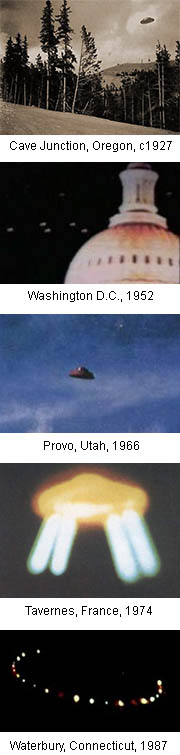
UFOs: Explained or Unexplainable?
Daytime UFO sightings are often discounted as reflections of the sun’s rays from airplanes, weather balloons, or other known objects and night sightings are dismissed as fireballs, meteors, or weather related phenomena. Yet, although they represent a small percentage, some sightings remain unexplained.2 As late as 1969, 30% of UFO cases remained unsolved.3 However, with modern technology, the J. Allen Hynek Center for UFO Studies (CUFOS) reports that today less than 10% of UFO sightings are unexplained.6
According to the US Central Intelligence Agency (CIA), 57% of Americans believe UFOs exist. Both former US Presidents Carter and Reagan believe they have seen a UFO.3 However, although they are among the most prestigious UFO sighters, they certainly aren’t the first!
UFO sightings may have occurred throughout history.
Medieval paintings, tapestries, frescoes and other art objects portray airborne saucers and the same domed saucer shapes that are similar to current UFO reports. Perhaps one of the earliest UFO sightings in the US occurred in Texas, described in the January 25, 1878 issue of The Denison Daily News. It was reported that local farmer, John Martin had seen a large, dark, circular object, resembling a balloon, flying “at wonderful speed.”4 Nearly three-quarters of a century later, pilot Kenneth Arnold estimated the speed of a similar object at 1000 MPH.
The 20th Century Brought UFOs to the public eye.
WWII was the advent of modern day UFO reports when Allied airplane crews reported seeing “foo-fighters”, blobs of light or fire in the Pacific and European theatres. Thought at the time to be the Axis’s “secret weapons,” the origin of foo-fighters remained unexplained at the end of the war.
In 1947, UFOs first made the headlines when private pilot Kenneth Arnold described his sighting of nine flying disks near Mount Rainier in Washington. In July 1947, a United Airlines crew also reported sighting nine disk-shaped objects over Idaho, an experience that turned skeptic Captain E.J. Smith into a believer in the existence of UFOs. Newspapers used the term “flying saucers” to describe the disks.5
US Government Investigates UFOs.
Believing that a broader definition than “flying saucers” was needed, in 1952, Captain Edward J. Ruppelt, the first director of Project Blue Book suggested the term UFO.
Preceded by Projects Sign and Grudge, in 1952, the US Air Force’s Project Blue Book became the major government effort to study the UFO phenomenon, resulting in several different reports until it was discontinued in 1967. Project Blue Book brought classification to types of UFOs:3
- Daylight disks
- Nocturnal lights
- Radar sightings (or combinations of radar and visual sightings).
- Close encounters of the first kind, when a witness reports being within 500 feet of a UFO.
- Close encounters of the second kind, when physical traces of a UFO are found.
- Close encounters of the third kind, when witnesses claim to encounter beings associated with a UFO.
UFO Investigative Organizations.
SETI (Search for Extra-Terrestrial Intelligence) Institute takes the search for UFOs into the Universe. Its mission is to detect intelligent extraterrestrial life, generally in searching the skies to find transmissions from civilizations on other planets in the Universe.
The mission of the UFO Research Coalition is to share resources and to fund and promote the scientific study of UFOs in collaboration with the three main UFO investigative organizations in the United States–FUFOR, MUNFON, and CUFOS.
- FUFOR is the Fund for UFO Research.
- The Mutual UFO Network (MUFON), currently headquartered in Fort Collins, Colorado, is one of the oldest and largest UFO investigative organizations in the United States.
- The J. Allen Hynek Center for UFO Studies (CUFOS) is an international group of scientists, academics, investigators, and volunteers dedicated to the continuing examination and analysis of the UFO phenomenon.
2.“unidentified flying object. The Columbia Encyclopedia, Sixth Edition. 2001-07.” Columbia Encyclopedia, 2001. http://www.bartleby.com/65/un/unidenti.html.“Center for UFO Studies.” http://www.cufos.org/. 10 April 2008
3.“CIA's Role in the Study of UFOs, 1947-90 — Central Intelligence Agency.” https://www.cia.gov/library/center-for-the-study-of-intelligence/csi-publications/csi-studies/studies/97unclass/ufo.html. 9 April 2008.
4.“Unidentified flying object - Wikipedia, the free encyclopedia.” http://en.wikipedia.org/wiki/UFO#First_modern_reports.9 April 2008.
5.“PROJECT 1947: UAL Flight 105, July 4, 1947 - Capt E. J. Smith.” http://www.project1947.com/fig/ual105.htm. 11 April 2008
6.“Center for UFO Studies.” http://www.cufos.org/FAQ_English_P1.html#what. 11 April 2008.